Understanding the principles of homeopathy starts with recognizing the importance of the physician’s knowledge. The 3rd aphorism of Dr. Samuel Hahnemann’s Organon of Medicine outlines the essential qualities and knowledge a true physician must possess. This knowledge is critical for treating patients effectively, rationally, and ethically. Without it, a physician cannot achieve the ideal cure or fulfill the mission of restoring health.
The Essence of the Physician’s Knowledge
Dr. Hahnemann emphasized that a physician’s understanding must go beyond superficial observation. At his time, many physicians lacked clarity on the type of knowledge required to treat a sick individual. In his work Medicine of Experience, he highlighted that the art of healing is rooted in three key areas:
- Knowledge of disease
- Knowledge of medicine
- Knowledge of how to employ medicine judiciously and rationally
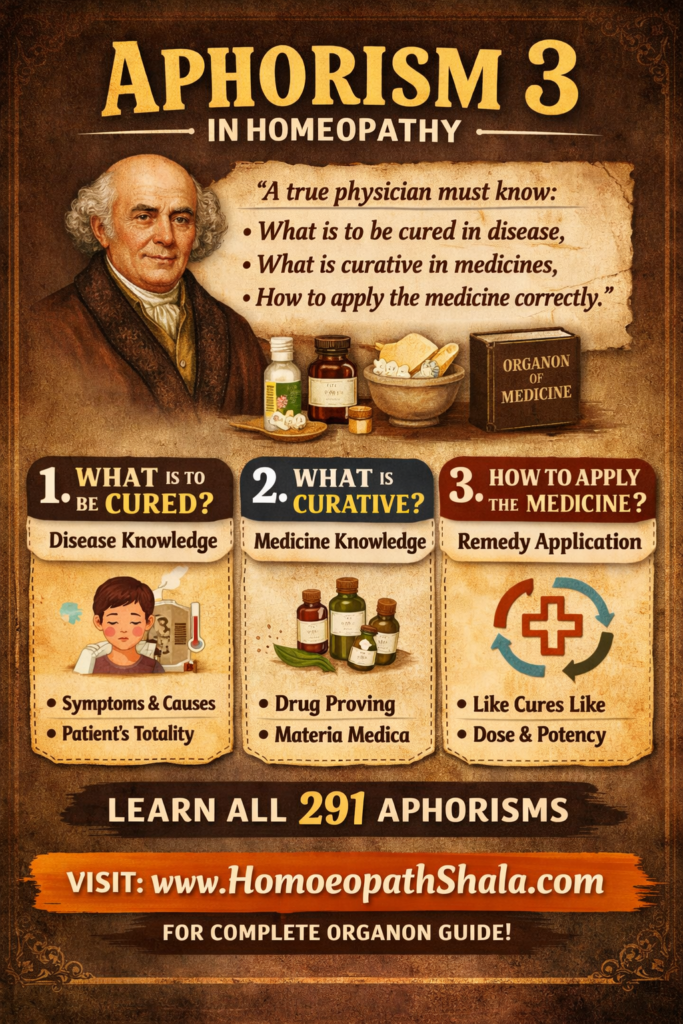
The terms “judicial” and “rational” refer to following a scientific, ethical, and experimentally verified method of treatment that respects the patient’s individuality.
Knowledge of Disease
Disease, according to homeopathy, is a disturbance of the vital force caused by harmful influences that affect the body’s dynamic balance. These disturbances create abnormal sensations and altered bodily functions, which manifest as signs and symptoms.
Importantly, Dr. Hahnemann stressed that physicians should perceive the disease rather than merely study it. Perception involves a comprehensive understanding of the patient, which cannot be captured by scientific analysis alone. It requires keen observation, reasoning, and the use of all senses to recognize aspects of the disease that may not fit conventional theories.
Individualization of Disease
A physician must treat each patient as a unique individual rather than merely as a representative of a disease category. Nosological classifications describe general patterns but fail to account for the peculiarities of each patient.
- General symptoms: Common features shared by a group of patients with the same disease.
- Peculiar symptoms: Unique characteristics that define the individual’s response and personality.
True knowledge of disease combines both general and peculiar symptoms. Treating patients based solely on the disease name ignores the individual’s uniqueness, which is essential for accurate homeopathic prescription.
Clinical Aspects of Disease
A physician must also perceive what is to be cured—distinguishing between health and disease. Clinical understanding includes:
- The causative factors of disease (exciting, fundamental, and maintaining causes)
- Signs and symptoms that indicate disease presence and progression
- Differentiating between common and uncommon symptoms
This knowledge helps in diagnosis, prognosis, and patient management, guiding physicians in individualized treatment plans. Classification of diseases as acute or chronic further informs perception and management strategies.
Knowledge of Medicine
Medicine in homeopathy refers to substances capable of altering the state of health. Dr. Hahnemann recognized that the true curative power of a drug can only be understood through observation of its action on healthy individuals, known as drug proving.
- Drugs produce dynamic reactions in individuals, much like diseases.
- The knowledge of medicine is based on observed effects, not speculation or indirect study of pathology.
- A drug’s sick-making property in a healthy person is its curative power in the sick.
This approach ensures that medicines are selected based on precise knowledge of the symptoms they can produce and cure.
Drug Proving and the Totality of Symptoms
Homeopathy uniquely studies both natural and artificial diseases:
- Natural diseases arise from known or unknown causes in patients.
- Artificial diseases are produced in healthy individuals through drug proving.
Drug proving allows physicians to understand the dynamic effects of medicines and their curative properties. By combining case-taking (knowledge of disease) and drug proving (knowledge of medicine), the physician achieves a complete understanding of the healing process.
The knowledge of the physician in homeopathy is a blend of observation, perception, reasoning, and scientific understanding. It includes:
- Understanding the individual nature of disease
- Individualizing treatment based on both general and peculiar symptoms
- Mastery of medicine through drug proving
- Judicious and rational application of remedies
Dr. Hahnemann’s vision was clear: only a physician equipped with this knowledge can provide the ideal cure and fulfill the mission of restoring health.